November 22, 2026
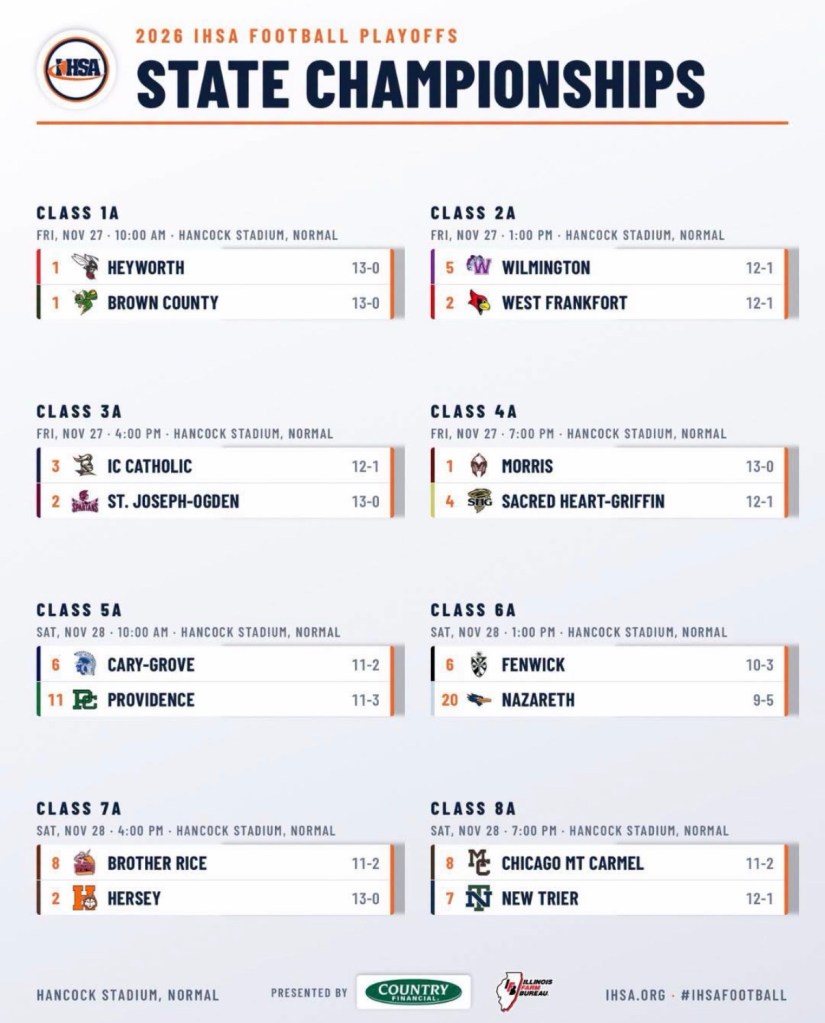
The IHSA football state championship field is set for Friday and Saturday at Hancock Stadium in Normal — and it is, once again, the public-private debate made flesh. Six of the eight state finals feature at least one private school. Seven of the 16 finalists are non-boundaried Catholic schools. Only the two smallest classes, 1A and 2A, will crown a public-school champion for certain.
The clearest example is Class 6A, where defending champion Oak Park Fenwick (10-3) plays LaGrange Park Nazareth Academy (9-5) on Saturday at 1 p.m. — an all-private final, the kind of championship game that could not happen under one of the proposals the IHSA is weighing right now.
The finals field
*Non-boundaried (private) school. All games at Hancock Stadium, Normal.
Saturday’s semifinals filled the field:
Heyworth 22, Stockton 8 and Brown County 14, Hardin Calhoun 12 in 1A
Wilmington 35, Aurora Christian 7 and West Frankfort 34, Nashville 7 in 2A
IC Catholic 21, Richmond-Burton 7 and St. Joseph-Ogden 48, Williamsville 9 in 3A
Morris 42, Coal City 7 and Sacred Heart-Griffin 31, Rochester 28 in 4A
Cary-Grove 41, Sycamore 10 and Providence Catholic 31, Mahomet-Seymour 28 in 5A
Fenwick 56, Harlem 35 and Nazareth 14, Wheaton Warrenville South 7 in 6A
Brother Rice 24, East St. Louis 12 and Hersey 21, Downers Grove North 10 in 7A
Chicago Mt. Carmel 38, Oswego 18 and New Trier 45, St. Ignatius 35 in 8A
Nazareth’s run is the longest shot of the bunch: the No. 20 seed, which entered the playoffs with a losing record, is playing for a state title. At the other end, five unbeaten public schools — Heyworth, Brown County, St. Joseph-Ogden, Morris and Hersey — carry perfect records into championship weekend.
Why the numbers stir the pot
Private schools make up only about 12 percent of the IHSA’s membership, yet they will supply nearly half the teams in Normal this weekend. It is not a one-year blip: in the 2024 state finals, seven of the eight champions crowned were private schools, and all seven won by 20 points or more. The IHSA already applies a 1.65 enrollment multiplier and a success formula to non-boundaried schools, and in recent years it has tightened its multiplier waiver guidelines, cutting the number of waivers granted in some sports from around 200 down to roughly 40. The debate has only gotten louder.
The changes on the table
Three of the 25 bylaw proposals in the IHSA’s 2026-27 legislative cycle take direct aim at the issue, and they do not fit together:
- Proposal 0 — the bigger multiplier. Submitted by Williamsville on behalf of the Sangamo Conference, it would raise the non-boundaried enrollment multiplier from 1.65 to 2.5, pushing private schools into higher classifications across the board. It is marked “To Be on Ballot” in the proposal packet.
- Proposal 8 — separate classifications. Submitted by the West Suburban Conference, it would put boundaried and non-boundaried schools in entirely separate classifications in sports with three or more classes. In football, private schools would play in two classes of their own and public schools in six — separate tournaments, separate champions.
- Proposal 15 — separate quadrants, one champion. Also from the West Suburban Conference, and the bylaw version of the idea the IHSA’s Competitive Balance Committee has discussed since the summer: boundaried and non-boundaried schools would be assigned to separate qualifying quadrants — a 3-1 model in which private schools play each other for one semifinal spot while public schools take the other three. One champion per class survives, but an all-private final like Fenwick–Nazareth could never happen again. The Board could also enact this one as policy without a membership vote.
The reaction from the private-school side has been blunt. Tim Chandler, vice president of the Chicago Catholic League and athletic director at St. Laurence, told the Sun-Times that if Proposal 8 were to pass, the private schools would consider branching away from the IHSA altogether. IHSA Executive Director Craig Anderson has said the Competitive Balance Committee deliberately stopped short of fully separate tournaments, in part over that very concern — that non-boundaried schools pushed into their own tournaments might question remaining in the association at all.
What happens next
The proposals were discussed at closed town meetings around the state from Nov. 5 through Nov. 18. On Monday, Nov. 23 — four days before the first final kicks off in Normal — the IHSA Legislative Commission reconvenes to decide which proposals go to the full membership. Those that make the ballot will be voted on by member schools Dec. 1-15, with results announced Dec. 16.
So while 16 teams play for eight trophies this weekend, the structure that produced this field is itself up for a vote. Whatever happens on the field in Normal, the argument over who should be on it is headed for a decision in December.
Sources: IHSA state championship pairings and semifinal results (WITY Radio, updated Nov. 21, 2026); WRMJ (Ty Taylor), Oct. 22, 2026; IHSA 2026-27 bylaw proposals packet; State Journal-Register, Nov. 3, 2026; Herald-Review, Nov. 7-8, 2026.
Muse AI Assisted

