(4-29-26) The Pennsylvania State House passed legislation on Wednesday that would allow the Pennsylvania Interscholastic Athletic Association (PIAA) to separate public and private schools into different postseason playoff systems.
The passage, by a vote of 178-23, of House Bill 41 allows the PIAA to separate boundary and non-boundary schools for postseason tournaments.
Pittsburgh Post-Gazette– State House passes bill that allows PIAA to conduct separate playoffs for public and private schools
Rep. Rob Matzie, D-Ambridge
“The vote count was even a little surprising to me. I didn’t think it would be that high. I think 178 votes says, ‘Hey, let’s take this up and let’s move on.
I think there is pressure on the Senate to do something based on that vote.”
The bill must now pass the Senate before going to Gov. Shapiro’s desk for a signature. No timeline has been made public when the bill will be discussed and voted on.
The next step would be for the PIAA’s Executive Board and the Pennsylvania Athletic Oversight Committee to hold public meetings in each district to gather testimony and comments from individuals regarding the seperation of playoffs.
RELATED:
- Pennsylvania School Superintendent Questions PIAA ‘What is the PIAA about?’
- Public Vs. Private Battle Fires Up In Pennsylvania
Other States who have made a change
In January, the Alabama High School Athletic Association voted, 13-2, to split private and public schools for the playoffs. The new playoff system will start this fall.
Alabama Lt. Governor
In March, 30 public schools in Southern Nevada decided to pull out of the Nevada Interscholastic Activities Association for football in protest of powerhouse Bishop Gorman, a Catholic school that takes players from anywhere and has won 15 of 16 state championships.
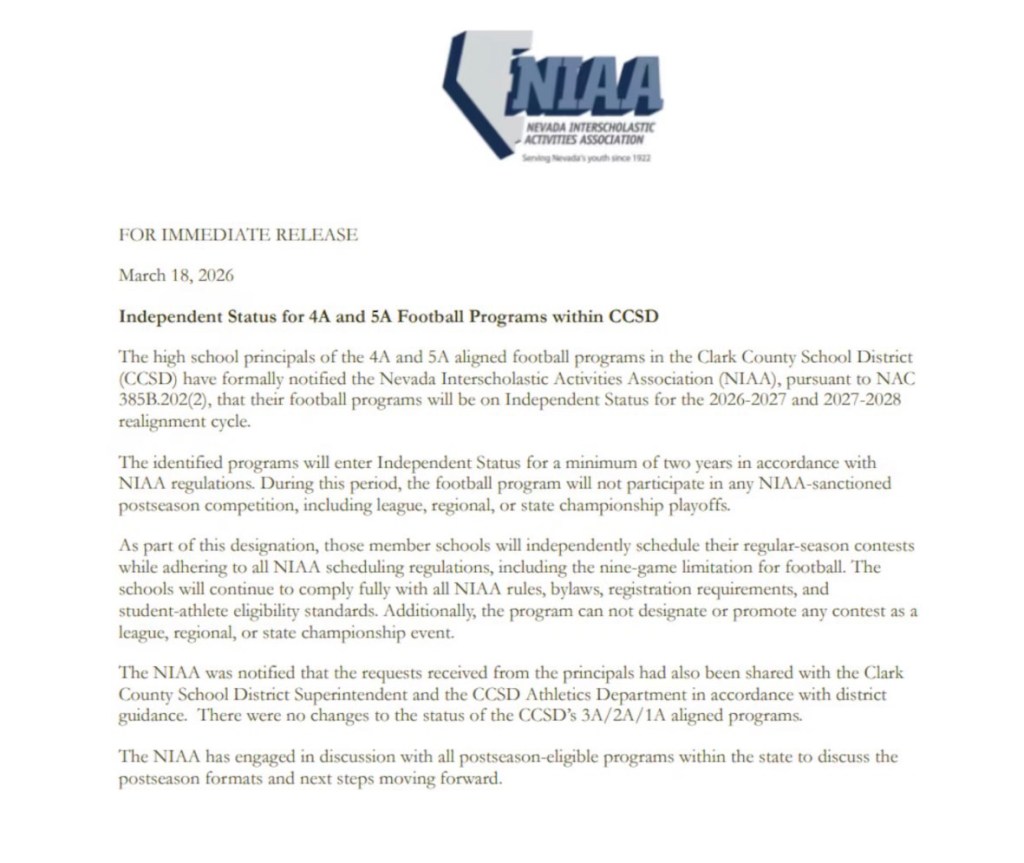
Clark County School District Education Services Division Associate Superintendent Kevin McPartlin (3-31-26)
“The Clark County School District (CCSD) supports the decision made by all of our 4A and 5A high school principals to transition their football programs to independent status for the 2026 and 2027 seasons. Principals made this decision to stand up for their student-athletes who were playing at a disadvantage. Just as we play by the same rules on the field, we must play by the same rules off the field.
“Currently, the disparities in transfer rules and eligibility requirements between traditional public schools and other member institutions have created an environment that is no longer equitable – and potentially is unsafe – for our students.
“By operating independently, our schools can curate schedules that prioritize safety, fair competition, and the integrity of the game. CCSD remains committed to working with all stakeholders to find a long-term, statewide solution that restores competitive balance for all Nevada student-athletes.“

